Cold Store Floors
Summary
Cold Store Floors - A cold store floor is a floor in a warehouse which is refrigerated in order to preserve the goods which it is storing.
Technical Information
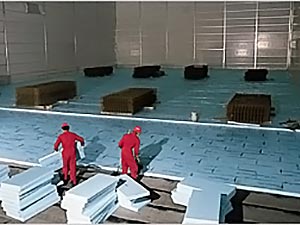
Concrete floors are used in cold stores with temperatures as low as -40oC. Fully matured concrete can perform well at these temperatures; however, immature concrete (with a compressive strength of less than 5N/mm2) may have its strength development curtailed by too early a reduction in temperature. It is therefore essential that cold store slabs are allowed to mature to develop their required strength before the temperature is reduced. A minimum of fourteen days should be provided for this purpose but more may be required depending on the concrete composition. As well as this, the working temperature of a cold store chamber should be achieved by gradual reduction over a number of days or weeks.
Because moisture is required for freeze-thaw damage to occur, it is not usually a problem for an industrial floor. However in exceptional circumstances where freeze-thaw will likely be a problem, air entraining admixtures can be used in the concrete to help combat it. However, great care must be taken when entraining air in a slab that is to be trowelled as it can lead to delamination.
In cold-store flooring systems, thermal expansion and contraction can be a problem if the floor is regularly allowed to return to room temperature during its service life. This is because the temperature range experienced in this case is much greater than that experienced by normal floors.
Please share this definition:


